Understand reference-lot and supplied-lot documentation, match records to your order and request missing lot information before purchasing.
Posted in
For laboratory research use only. Not for human consumption. Products are not for veterinary use, diagnosis, treatment, clinical application, food, cosmetic, or household use.

Understand reference-lot and supplied-lot documentation, match records to your order and request missing lot information before purchasing.
Compare peptide COAs by product, size, lot, methods and reported results. Identify documentation gaps before laboratory purchasing.
A research-focused explanation of mass, concentration, and biological activity units used in analytical documentation.
A research-only guide to mL and microliter conversion, measurement records, equipment range, and analytical uncertainty.
PNC-27 is a synthetic peptide that fuses a p53–derived HDM-2–binding domain to a membrane-penetrating “leader” sequence. In published laboratory studies, it has been investigated for selectively inducing membrane disruption (necrosis) in cancer cells that express HDM-2 at their plasma membrane, while reportedly sparing normal cells in those same in-vitro models. PNC-27 is an experimental research […]
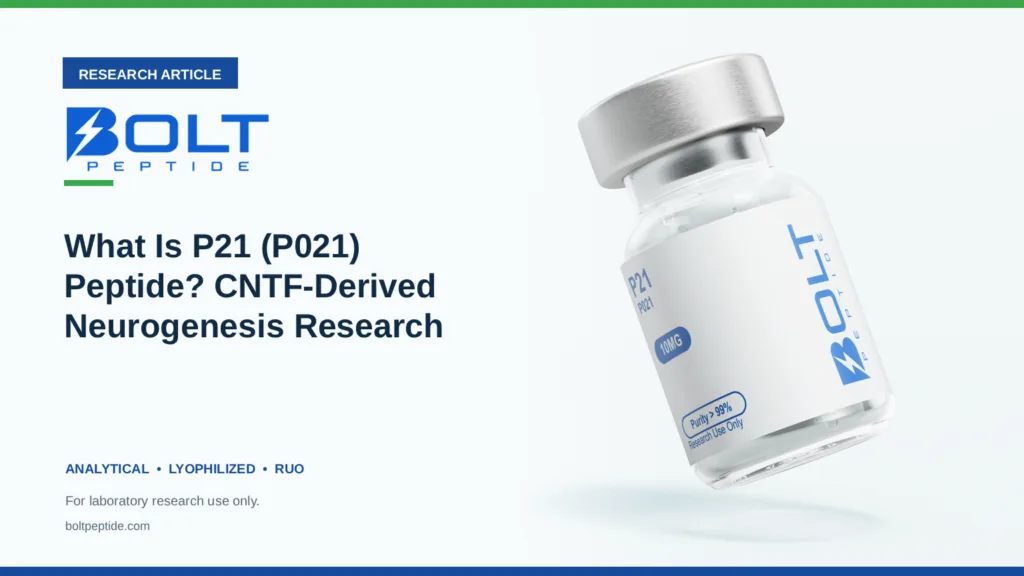
P21, also written P021, is a small synthetic peptidergic compound derived from a biologically active region of ciliary neurotrophic factor (CNTF), chemically modified for stability and blood–brain-barrier penetration and studied in laboratory models of neurogenesis and neurodegeneration. Its core sequence (Ac–DGGLAG–NH2) is derived from the most active region of CNTF, with an adamantane group added […]
B7-33 is a synthetic single-chain peptide derived from the hormone H2 relaxin (relaxin-2), designed to retain relaxin’s anti-fibrotic signaling through the RXFP1 receptor while being far simpler and cheaper to synthesize than the native two-chain hormone. In preclinical and in-vitro tissue-fibrosis research, it has been characterized as a “biased” or functionally selective RXFP1 agonist. This […]
Cerebrolysin is a peptide preparation derived from purified porcine (pig) brain proteins, consisting of low-molecular-weight neuropeptides and free amino acids. It is studied in neurological and neurodegeneration research as a proposed neurotrophic agent — a substance investigated for its ability to mimic the activity of the brain’s own nerve-growth signals. This article is educational only. […]
Modified GRF 1-29 is a synthetic analog of the first 29 amino acids of growth-hormone-releasing hormone (GHRH 1-29, the same core sequence as sermorelin), carrying four amino-acid substitutions that improve its stability against enzymatic breakdown. It is most commonly marketed under the name “CJC-1295 without DAC,” and in laboratory models it acts as an agonist […]
Peptide bioregulators are short peptides — often di-, tri-, or tetrapeptides, or tissue-derived peptide complexes — that have been studied for tissue-specific regulatory effects. They were developed largely by Vladimir Khavinson and colleagues in Russia and have been investigated primarily in gerontology and cell-regulation research. This article is an educational overview for researchers comparing compounds […]