
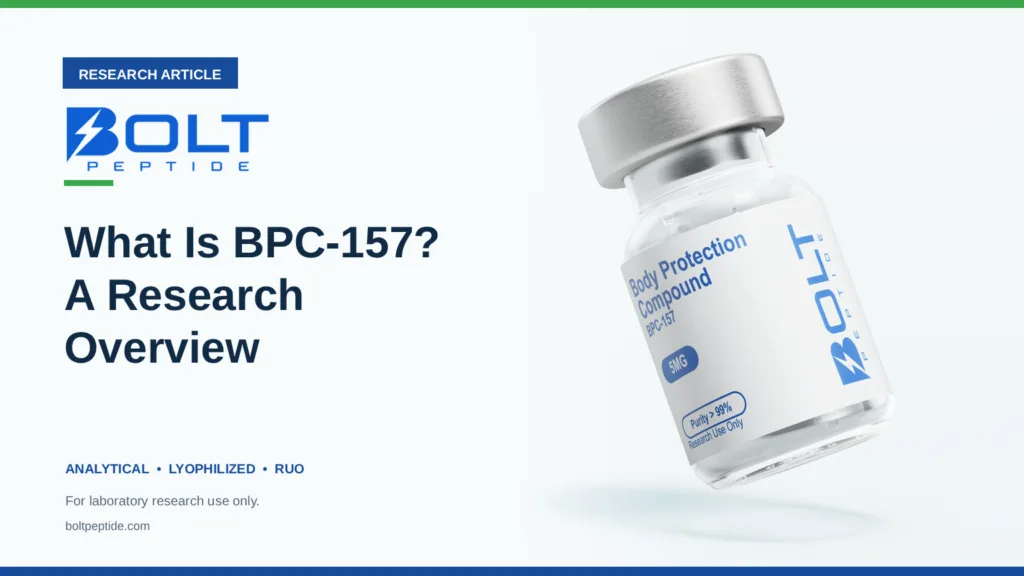
BPC-157 is a synthetic, stable pentadecapeptide — a chain of 15 amino acids derived from a protective protein sequence found in human gastric juice. In laboratory settings it is studied as a tissue-repair and angiogenesis research compound. It is sold strictly for laboratory research use only — not for human or veterinary use.
Quick facts
- Class: synthetic pentadecapeptide (15 amino acids)
- Also called: Body Protection Compound-157, PL 14736
- Origin: partial sequence of gastric “body protection compound”
- Form: lyophilized powder
What is BPC-157?
BPC-157 is a stable gastric pentadecapeptide first isolated from a protective fragment of human gastric juice. Because it remains stable in aqueous solution, it is widely used as a model compound in preclinical tissue-repair research.
What does the research show?
Current evidence is preclinical — drawn from in-vitro and animal models. A 2025 systematic review identified 36 studies (35 preclinical, 1 clinical), reporting that in these models BPC-157 was associated with markers of angiogenesis, collagen synthesis, and modulation of cell-growth pathways. In a foundational 2011 study, BPC-157 promoted the outgrowth, survival, and migration of tendon fibroblasts in vitro, an effect linked to the FAK–paxillin signaling pathway. Review articles also describe research interest in gastrointestinal, muscle, ligament, and bone-tissue models.
Mechanisms studied in the lab
- Angiogenesis — blood-vessel formation and improved blood flow in ischemic animal tissue
- Nitric-oxide pathway modulation
- Growth-factor and cytokine signaling — increased growth-hormone-receptor expression and reduced inflammatory cytokines in models
Research status and safety
Findings to date are limited to laboratory and animal research. Animal studies have reported no harmful effects, but there is no established clinical safety or efficacy data in humans. BPC-157 is not approved for human use and is supplied for in-vitro research only.
Handling and storage
BPC-157 is supplied as a lyophilized research material. Qualified laboratory personnel must establish storage, solvent compatibility, material handling, and final concentration under documented institutional SOPs. See the BPC-157 product details and browse the research peptide catalog.
Frequently asked questions
Is BPC-157 approved for human use?
No. BPC-157 is a research-use-only compound. It is not approved by the FDA and is not intended for human or veterinary use.
What form does BPC-157 come in?
It is supplied as a lyophilized research material for controlled in-vitro laboratory study by qualified professionals.
What is the difference between BPC-157 and TB-500?
Both are studied in tissue-repair research, but they are distinct compounds with different sequences and mechanisms. TB-500 is a synthetic fragment related to thymosin beta-4.
References
- Chang C-H, et al. The promoting effect of pentadecapeptide BPC 157 on tendon healing involves tendon outgrowth, cell survival, and cell migration. J Appl Physiol, 2011. PubMed
- Vasireddi N, et al. Emerging Use of BPC-157 in Orthopaedic Sports Medicine: A Systematic Review. 2025. Journal
- Tissue Repair Perspectives with Stable Gastric Pentadecapeptide BPC 157 — A Review. Pharmaceuticals (MDPI), 2025. Article
For research use only. Not for human or veterinary use. Statements have not been evaluated by the Food and Drug Administration. This article is provided for educational and scientific information only and does not constitute medical advice.
Source research-grade peptides from Bolt Peptide
Review current product availability and available documentation before ordering. Reference-lot records do not confirm the lot that will ship. For research use only.
BPC-157 research peptide →Shop all research peptides