
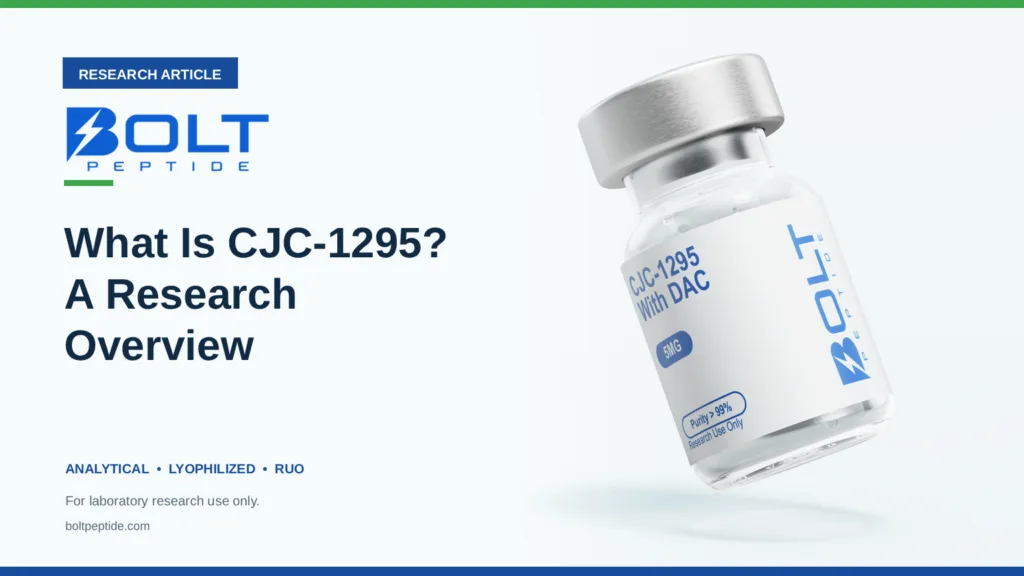
CJC-1295 is a synthetic analog of growth-hormone-releasing hormone (GHRH) — specifically a modified hGRF(1–29) peptide — studied in laboratory and animal models as a long-acting growth-hormone secretagogue that activates the GHRH receptor on the anterior pituitary. This compound is offered strictly for research use only (RUO). It is not for human use, is not a drug or dietary supplement, and is not approved by the FDA.
Quick facts
- Class: GHRH analog / growth-hormone secretagogue (modified hGRF[1–29]).
- Variants: studied as “with DAC” (Drug Affinity Complex, an albumin-binding form) and “no DAC” (also called modified GRF[1–29]).
- Research focus: GH-axis and GHRH-receptor signaling research.
- Form: lyophilized powder for laboratory research use only.
What is CJC-1295?
CJC-1295 is a 29–amino-acid peptide derived from the N-terminal fragment of human growth-hormone-releasing factor, hGRF(1–29). Researchers introduced amino-acid substitutions to resist enzymatic breakdown (such as cleavage by dipeptidyl peptidase-IV), and, in the “with DAC” version, added a Drug Affinity Complex — a maleimide linker that lets the peptide bind covalently to circulating serum albumin. In the literature, the original albumin-binding bioconjugate is the compound first designated CJC-1295. The “no DAC” form omits this linker and is commonly referred to as modified GRF(1–29).
What does the research show?
Preclinical work in rats first identified CJC-1295 as a long-acting hGRF(1–29) analog. In that study, albumin bioconjugates activated the GRF receptor on the anterior pituitary, and CJC-1295 produced a marked, sustained increase in growth-hormone exposure versus unmodified hGRF(1–29) [1]. Subsequent controlled human pharmacology studies — reported here only to characterize the molecule, not to suggest any human application — described dose-dependent, sustained elevations in mean GH and IGF-I and an estimated half-life on the order of several days [2]. A related investigation reported that pulsatile GH secretion persisted during continuous GHRH stimulation by CJC-1295 [3]. These findings describe observations in research settings only.
Mechanisms studied in the lab
- GHRH-receptor agonism: CJC-1295 binds and activates the GHRH (GRF) receptor on anterior-pituitary cells, the same target as endogenous GHRH [1].
- DAC albumin binding: in the with-DAC form, a reactive maleimide linker forms a covalent bond with serum albumin, shielding the peptide from rapid clearance and extending its measured plasma half-life relative to native GHRH.
- Enzymatic resistance: sequence modifications reduce susceptibility to dipeptidyl peptidase-IV cleavage, contributing to the prolonged time-course observed in preclinical models.
Research status and safety
CJC-1295 is supplied for research use only. It is not a medicine, supplement, or food, and is not intended to diagnose, treat, cure, or prevent any condition. It is not approved by the FDA for human or veterinary use and must not be administered to humans or animals. Nothing on this page constitutes medical advice or dosing guidance, and no dosing information is provided.
Handling
CJC-1295 ships as a lyophilized (freeze-dried) powder, stored cold and protected from light until use. For general laboratory technique, see our guide on laboratory concentration and handling reference. CJC-1295 is frequently studied alongside ipamorelin in preclinical GH-axis research. Browse related compounds in the catalog. Product details: CJC-1295 — product details.
FAQ
CJC-1295 with DAC vs. no DAC — what is the difference? The with-DAC form carries a Drug Affinity Complex linker that binds serum albumin, associated with a substantially longer measured plasma half-life in studies. The no-DAC form (modified GRF[1–29]) lacks this linker and shows a much shorter circulating time-course. The DAC primarily affects how long the peptide remains in circulation, not how it engages the receptor.
Why is CJC-1295 studied together with ipamorelin? They act on different pathways — CJC-1295 on the GHRH receptor and ipamorelin as a ghrelin-receptor agonist — so they are commonly paired in laboratory models examining the GH axis. This is a research design choice, not a recommendation for any use.
Is CJC-1295 approved for human use? No. It is a research compound only, not FDA-approved, and not intended for human or veterinary administration.
References
- Jetté L, et al. hGRF(1-29)-albumin bioconjugates activate the GRF receptor: CJC-1295 as a long-lasting GRF analog. Endocrinology. 2005.
- Teichman SL, et al. Prolonged stimulation of GH and IGF-I secretion by CJC-1295. J Clin Endocrinol Metab. 2006.
- Ionescu M, Frohman LA. Pulsatile GH secretion persists during continuous stimulation by CJC-1295. J Clin Endocrinol Metab. 2006.
For research use only. Not for human or veterinary use. Not FDA-approved. Statements have not been evaluated by the FDA.
Source research-grade peptides from Bolt Peptide
Review current product availability and available documentation before ordering. Reference-lot records do not confirm the lot that will ship. For research use only.
Shop CJC-1295 →Shop all research peptides