
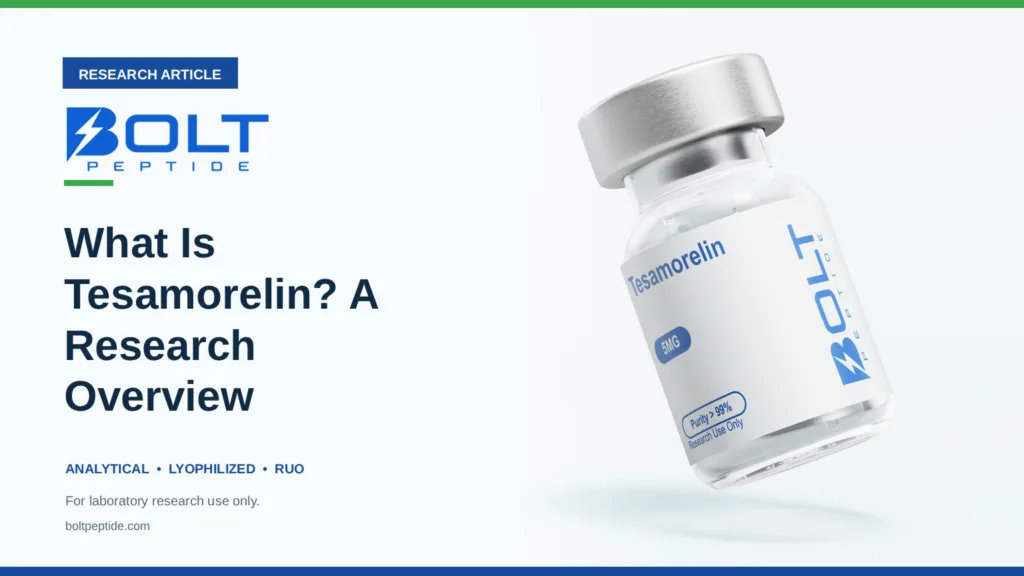
Tesamorelin is a synthetic growth hormone–releasing hormone (GHRH) analog studied in clinical and preclinical literature for its interaction with the GH / IGF-1 axis. Bolt Peptide supplies only research-use-only material for controlled in-vitro laboratory investigation by qualified professionals. It is not a finished pharmaceutical product and is not for human use.
Quick facts
- Class: GHRH (growth hormone–releasing hormone) analog
- Research focus: GH / IGF-1 axis research
- Structure: modified 44–amino acid human GHRH sequence with an N-terminal hexenoyl modification
- Form: lyophilized powder for laboratory research use only
What is Tesamorelin?
Tesamorelin is a stabilized analog of human growth hormone–releasing hormone. Structurally, it is a synthetically produced 44–amino acid sequence of human GHRH with a hexenoyl moiety attached to the tyrosine residue at the amino terminus. This modification is reported to confer resistance to degradation by the enzyme dipeptidyl peptidase-4 (DPP-4), extending stability relative to native GHRH. As a GHRH analog, it is used in research as a tool to investigate how a GHRH-receptor agonist influences endogenous GH secretion and downstream IGF-1 signaling.
What does the research show?
Published clinical research describes outcomes observed in study participants, not in any reader of this article. In phase 3 randomized controlled trials in adults with HIV-associated lipodystrophy, investigators reported that tesamorelin reduced visceral adipose tissue compared with placebo over 26 weeks, alongside increases in serum IGF-1 [1][2]. A 2026 meta-analysis pooling randomized controlled trials reported associations with reductions in visceral adipose tissue, trunk fat, and hepatic fat percentage, along with improvements in IGF-1 levels [3]. These findings are attributed to the published trial populations and are presented strictly to summarize the scientific literature.
Mechanisms studied in the lab
- GHRH receptor agonism: studied as an agonist at the GHRH receptor on anterior pituitary cells.
- GH release: research describes stimulation of endogenous GH secretion in a pattern characterized as more physiological than direct GH administration.
- IGF-1 axis: increased GH secretion is associated in the literature with elevated downstream IGF-1, a key readout in GH/IGF-1 axis studies.
- Enzymatic stability: the N-terminal modification is studied for conferring resistance to DPP-4 degradation.
Research status and safety
The tesamorelin material described here is supplied exclusively for controlled in-vitro laboratory and analytical research by qualified personnel. It is not for human or veterinary use or consumption, and no commercial or regulated product status applies to Bolt Peptide material.
Handling
Tesamorelin is supplied in lyophilized form. Qualified laboratory personnel must establish storage, solvent compatibility, material handling, and final concentration under an approved protocol and SOP. See the laboratory concentration and handling reference, browse the research catalog, or review Tesamorelin product details.
FAQ
Is tesamorelin a peptide or a hormone? Tesamorelin is a synthetic peptide analog of the hormone GHRH. In research it is classified as a GHRH-receptor agonist peptide.
Is this a finished pharmaceutical product? No. Bolt Peptide supplies a research-use-only reference material for controlled laboratory work. It is not for human use.
What axis does tesamorelin research focus on? Studies center on the GH / IGF-1 axis — how a DPP-4–resistant GHRH analog stimulates endogenous GH release and downstream IGF-1.
References
- Bedimo R. Growth hormone and tesamorelin in HIV-associated lipodystrophy. HIV AIDS (Auckl). 2011.
- Spooner LM, Olin JL. Tesamorelin: a GHRH analogue for HIV-associated lipodystrophy. Ann Pharmacother. 2012.
- Badran AS, et al. Body composition and metabolic outcomes of tesamorelin: a meta-analysis of RCTs. Obes Res Clin Pract. 2026.
For research use only. Not for human or veterinary use. The research material is not the FDA-approved medicine. Statements have not been evaluated by the FDA.
Source research-grade peptides from Bolt Peptide
Review current product availability and available documentation before ordering. Reference-lot records do not confirm the lot that will ship. For research use only.
Browse Research Peptides →