
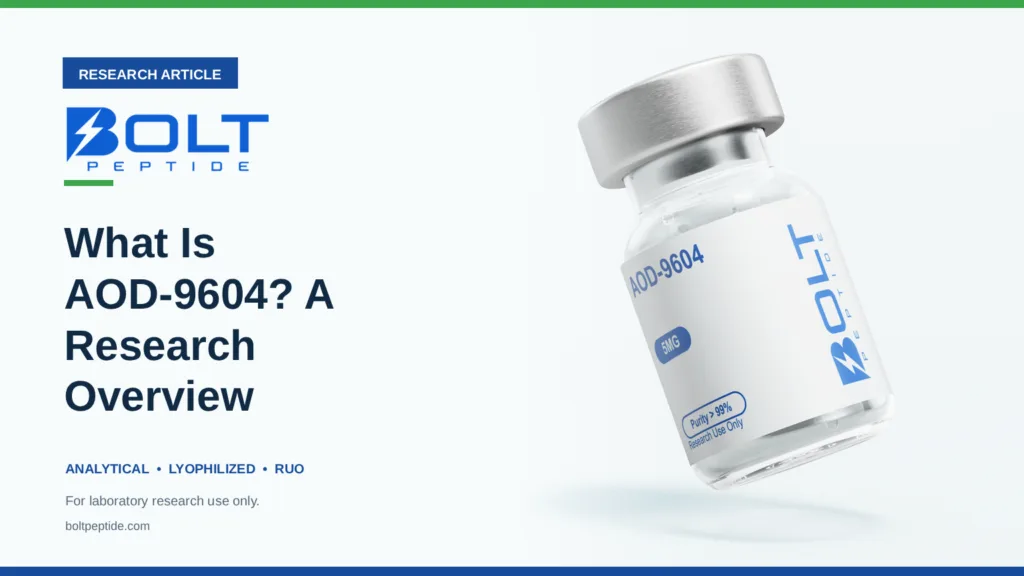
AOD-9604 is a synthetic peptide corresponding to the C-terminal fragment of human growth hormone (hGH 176–191), studied in preclinical and in-vitro models for its effects on lipid metabolism and, more recently, cartilage tissue. It is offered strictly for laboratory research use only (RUO). It is not a drug, is not approved by the FDA, and is not intended for human or veterinary use, diagnosis, or treatment.
Quick facts
- Identity: synthetic C-terminal fragment of human growth hormone (hGH 176–191), with a tyrosine residue added at the N-terminus.
- Research focus: lipid-metabolism research; more recent work explores cartilage and joint-tissue models.
- Form: lyophilized powder for laboratory research use only.
- Classification: research chemical — for in-vitro and laboratory research only.
What is AOD-9604?
AOD-9604 (also written AOD9604) is a short, 16-amino-acid synthetic peptide. Its sequence is based on the final region of the human growth hormone molecule — residues 176 through 191 — a segment researchers identified as associated with lipid-metabolism activity in early studies. A tyrosine residue was added to the N-terminus of the natural fragment to create the AOD-9604 analogue. Because it represents only a small portion of the full hormone, AOD-9604 is studied as a structurally distinct molecule rather than as growth hormone itself.
What does the research show?
Published research on AOD-9604 is preclinical — conducted in cell cultures and animal models, not in the general population. In an early study in obese (Zucker) rats, AOD-9604 was associated with reduced body-weight gain and increased lipolytic activity in adipose tissue, while — unlike intact growth hormone — it showed no adverse effect on insulin sensitivity in that model [1]. A subsequent study in obese mice and β3-adrenergic-receptor (β3-AR) knock-out mice examined how AOD-9604 acts at the tissue level; chronic treatment in obese mice was associated with changes in lipid metabolism that correlated with expression of the β3-AR, and in knock-out mice several of these effects were not reproduced [2]. More recent preclinical work has moved beyond metabolism: in a collagenase-induced rabbit osteoarthritis model, intra-articular AOD-9604 — particularly when combined with hyaluronic acid — was associated with greater cartilage regeneration than control injections in that animal model [3]. These findings describe outcomes observed in animals and isolated tissue only.
Mechanisms studied in the lab
- Investigated for effects on adipocyte lipid metabolism, including lipolysis and lipogenesis, in cell and animal models [1][2].
- Studied in relation to β3-adrenergic-receptor signalling pathways in fat tissue [2].
- Reported in preclinical studies to act without binding the growth-hormone receptor in the way intact hGH does, and without raising IGF-1 in the models tested [2].
- Explored in cartilage and joint-tissue models for effects on extracellular-matrix components [3].
Research status and safety
AOD-9604 is a research compound. It is not approved by the FDA for any use, is not a dietary supplement, and is not intended for human or animal consumption. All available data come from laboratory and animal studies; nothing here should be read as describing an effect, benefit, or outcome in people. These statements have not been evaluated by the Food and Drug Administration.
Handling
AOD-9604 is supplied as a lyophilized (freeze-dried) powder, which supports stability during shipping and storage. For laboratory preparation, see our guide on laboratory concentration and handling reference. You can view this product and related compounds in the catalog: AOD-9604 — product details
FAQ
Is AOD-9604 the same as HGH Fragment 176–191? They are closely related but not identical. AOD-9604 is based on the hGH 176–191 fragment but carries an additional tyrosine residue at the N-terminus, making it a distinct synthetic analogue.
Does AOD-9604 raise IGF-1 like growth hormone? In the preclinical models cited here, AOD-9604 did not act on the growth-hormone receptor the way intact hGH does and did not raise IGF-1. These are research-model observations, not statements about humans.
Can I use AOD-9604 for personal health goals? No. AOD-9604 is sold for research use only. It is not approved for human use and is not a supplement, food, or medicine.
References
- Ng FM, et al. Metabolic studies of a synthetic lipolytic domain (AOD9604) of human growth hormone. Horm Res. 2000.
- Heffernan M, et al. Effects of hGH and its lipolytic fragment (AOD9604) on lipid metabolism. Endocrinology. 2001.
- Kwon DR, Park GY. Intra-articular AOD9604 in a rabbit osteoarthritis model. Ann Clin Lab Sci. 2015.
For research use only. Not for human or veterinary use. Not FDA-approved. Statements have not been evaluated by the FDA.
Source research-grade peptides from Bolt Peptide
Review current product availability and available documentation before ordering. Reference-lot records do not confirm the lot that will ship. For research use only.
Shop AOD-9604 →Shop all research peptides