
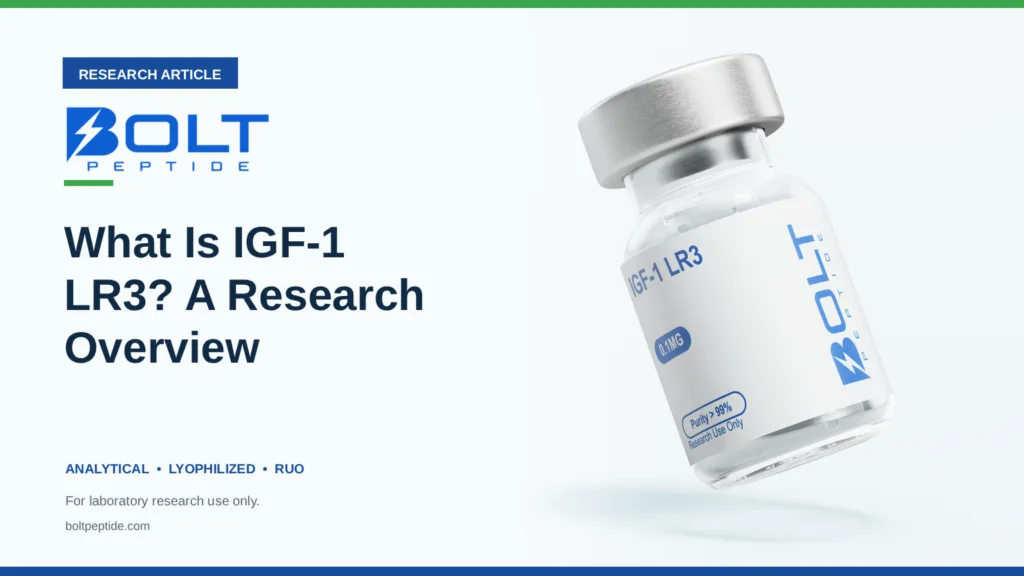
IGF-1 LR3 (Long R3 Insulin-like Growth Factor-1) is a synthetic, long-acting analog of native IGF-1 used as a reference compound in laboratory growth-factor and IGF-receptor research. It differs from native IGF-1 by an arginine substitution at position 3 (Arg3) and a 13-amino-acid N-terminal extension, modifications that sharply reduce its binding to IGF-binding proteins (IGFBPs) and extend its half-life in experimental systems. IGF-1 LR3 is sold strictly for research use only (RUO). It is not a drug, is not FDA-approved, and is not intended for human or veterinary use. These statements have not been evaluated by the Food and Drug Administration.
Quick facts
- Class: long-acting IGF-1 analog (Arg3 substitution + 13-amino-acid N-terminal extension)
- Research focus: growth-factor and IGF-receptor signaling research; serum-free cell-culture studies
- Form: lyophilized powder for laboratory research use only
- Status: research use only — not for human or animal use; not FDA-approved
What is IGF-1 LR3?
Native IGF-1 is a 70-amino-acid polypeptide central to studies of cell growth and metabolic signaling. IGF-1 LR3 is an engineered variant designed for laboratory work. Two structural changes define it: the glutamic acid at position 3 is replaced with arginine (the “R3” designation), and a 13-amino-acid extension is added to the N-terminus (the “Long” designation). Together these modifications produce a molecule that behaves differently from native IGF-1 in experimental systems — chiefly by largely escaping the IGFBP family of carrier proteins that normally sequester circulating IGF-1.
What does the research show?
Published preclinical and in-vitro studies have characterized how IGF-1 LR3 behaves in laboratory models. In serum-free culture of human embryonic kidney (HEK293) cells, Long R3 IGF-I supported cell growth and survival at concentrations far lower than insulin and acted as a more potent growth and survival factor than either insulin or native IGF-I, activating the type I IGF receptor in a dose-responsive manner [1]. In in-vitro–produced bovine embryos, long R3 IGF-I and native IGF-I differentially affected early development and the messenger-RNA abundance of IGF-binding proteins and type I IGF receptors — the two molecules showing distinct regulatory patterns [2]. A review of IGF-1 biology notes that the LR3 modifications confer much lower affinity for IGFBPs, a significantly longer half-life, and increased potency relative to wild-type IGF-1 in laboratory measures [3]. These findings describe behavior observed only in cell-culture and animal-research settings.
Mechanisms studied in the lab
- IGF-1 receptor signaling: in experimental systems, IGF-1 LR3 binds and activates the type I IGF receptor (IGF-1R), the entry point for IGF-1 signaling studied in cell models [1].
- Reduced IGFBP binding and extended half-life: the Arg3 substitution and N-terminal extension markedly lower affinity for IGF-binding proteins, so less of the molecule is sequestered by carrier proteins — a property associated with its longer measured half-life in research models [3].
Research status and safety
IGF-1 LR3 is offered exclusively as a research chemical for research use only. It is not a dietary supplement, not a medicine, and not approved by the FDA for any therapeutic indication. It is not intended for human or veterinary use, and nothing here should be interpreted as a recommendation to administer it to people or animals. These statements have not been evaluated by the Food and Drug Administration.
Handling
IGF-1 LR3 is supplied as a lyophilized (freeze-dried) powder, typically kept cold and protected from light and moisture until a study calls for it to be brought into solution. For general laboratory background, see our guide on laboratory concentration and handling reference, and browse related reference compounds in the catalog. Product details for this item are available here: IGF-1 LR3 — product details.
FAQ
How is IGF-1 LR3 different from native IGF-1? IGF-1 LR3 carries an arginine substitution at position 3 and a 13-amino-acid N-terminal extension. These changes give it much lower affinity for IGF-binding proteins and a longer half-life in laboratory models, whereas native IGF-1 binds IGFBPs strongly and is largely carrier-bound in circulation.
What is IGF-1 LR3 used for? In documented use it is a reference reagent for in-vitro and preclinical growth-factor and IGF-receptor research, including serum-free cell-culture studies. It is for research use only and is not for human or animal use.
Is IGF-1 LR3 approved by the FDA? No. It is not FDA-approved and is not intended for human or veterinary use. It is sold strictly as a research chemical.
References
- Voorhamme D, Yandell CA. LONG R3IGF-I in serum-free culture of HEK293 cells. Mol Biotechnol. 2006.
- Prelle K, et al. IGF-I and long R3 IGF-I in bovine embryos. Endocrinology. 2001.
- Bailes J, Soloviev M. Insulin-Like Growth Factor-1 (IGF-1) (review). Biomolecules. 2021.
For research use only. Not for human or veterinary use. Not FDA-approved. Statements have not been evaluated by the FDA.
Source research-grade peptides from Bolt Peptide
Review current product availability and available documentation before ordering. Reference-lot records do not confirm the lot that will ship. For research use only.
Browse Research Peptides →