
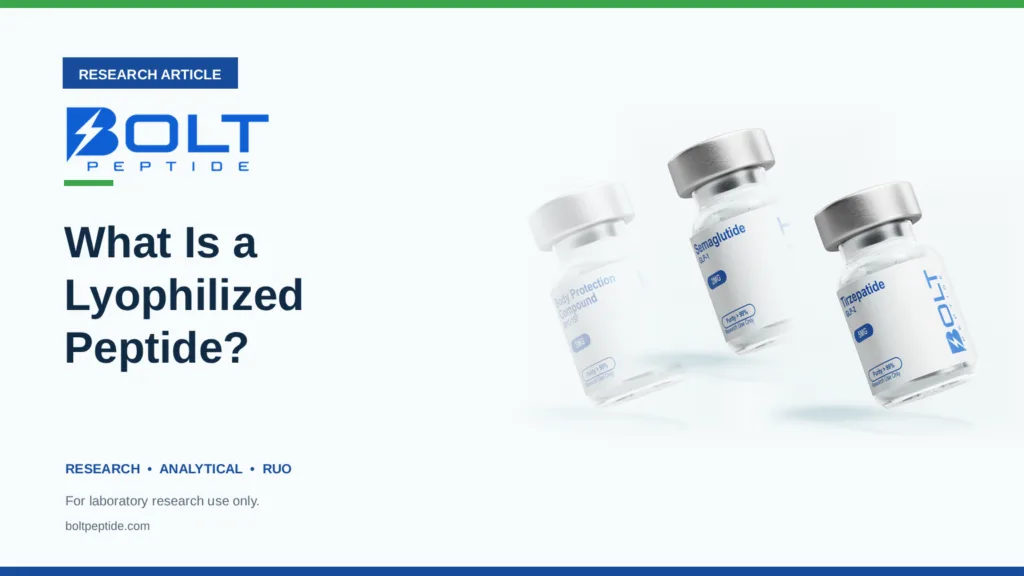
A lyophilized peptide is a peptide material from which water has been removed by freeze-drying. Lyophilization is widely used to place biomolecules into a low-moisture solid state for shipping, storage, and controlled laboratory study.
Research Use Only. The information below describes material science and analytical documentation for qualified laboratory personnel. It is not intended for human or veterinary use.
What lyophilization means
Lyophilization commonly includes freezing, primary drying under reduced pressure, and secondary drying. The process can reduce water-driven degradation, but its success depends on the formulation, process parameters, residual moisture, and container closure. The word lyophilized describes a physical process; it does not by itself establish identity, purity, sterility, potency, or suitability for an assay.
Appearance is not a quality result
Depending on mass, excipients, vial geometry, and drying conditions, lyophilized material may appear as a porous solid, powder, film, flakes, or a barely visible residue. Visual appearance alone cannot confirm the amount or composition of material in a vial. Those questions require controlled records and suitable analytical methods.
Evidence qualified researchers should review
- Identity: an appropriate method such as mass spectrometry may support molecular identity.
- Purity: a chromatographic method such as HPLC may report the relative purity of the submitted sample.
- Lot traceability: the vial, order record, and report should reference the same lot or batch.
- Method details: the report should identify the test, result, date, and testing laboratory.
- Material controls: label conditions, container integrity, and chain-of-custody records remain relevant after testing.
Where a purity specification applies, it is a product-specific target and not a substitute for a lot-specific result. Researchers should review the independent laboratory report for the applicable product and lot before relying on a stated purity.
Scientific limitation
A COA is evidence about the tests reported on that document; it is not a universal certificate for every characteristic of the material. Likewise, lyophilization may improve solid-state stability but does not eliminate the need for label-specific storage controls, approved protocols, and laboratory SOPs.
References
- Wang W. Lyophilization and development of solid protein pharmaceuticals.
- Chen Y, et al. Pharmaceutical protein solids: drying, characterization and stability.
- Karunnanithy V, et al. Lyoprotectants in protein stabilization during lyophilization.
For in-vitro laboratory research and analytical use only. Not for human or veterinary use.
Source research-grade peptides from Bolt Peptide
Review current product availability and available documentation before ordering. Reference-lot records do not confirm the lot that will ship. For research use only.
Browse Research Peptides →