
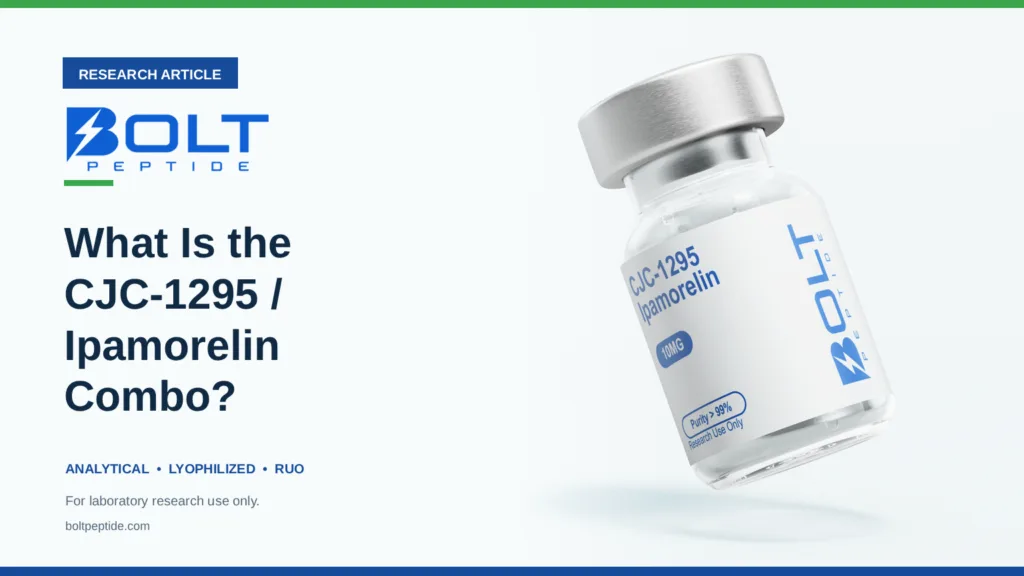
The CJC-1295 / Ipamorelin combo is a single research preparation that pairs CJC-1295 — a growth-hormone-releasing hormone (GHRH) analog that acts on the GHRH receptor (GHRH-R) — with Ipamorelin, a selective ghrelin/growth-hormone-secretagogue (GHS-R) receptor agonist. The two are blended together because, in preclinical and laboratory research, they engage two distinct and complementary nodes of the growth-hormone (GH) axis rather than the same one.
Research-use-only (RUO) note: this article describes laboratory and animal research findings. The combination is intended for in-vitro and non-human research only. It is not a drug, is not FDA-approved, and is not for human use.
What is in the combo?
- CJC-1295 — a synthetic GHRH analog. In published research it binds the GHRH receptor and, in long-acting formulations, attaches to plasma albumin to extend its duration of activity.
- Ipamorelin — a pentapeptide described in the literature as the first selective GH secretagogue. It acts on the GHS-R1a (ghrelin) receptor, a different receptor from the one CJC-1295 targets.
Why are CJC-1295 and Ipamorelin combined?
The two peptides are paired in research preparations because they are reported to act through separate but parallel signaling pathways of the GH axis. CJC-1295 engages the GHRH-R pathway (classically associated with cAMP signaling), while Ipamorelin engages the GHS-R1a pathway (associated with phospholipase C and intracellular calcium release). Because these are distinct receptor systems, investigators have studied them together to observe how the two complementary inputs behave in the same model. For a side-by-side breakdown, see our CJC-1295 vs Ipamorelin comparison.
CJC-1295 in research
A randomized, placebo-controlled study characterized CJC-1295 pharmacokinetics and reported prolonged changes in measured plasma GH and IGF-I. This historical study is summarized only as part of the published scientific record; it does not define a route, amount, or protocol for any Bolt material. For more, see the CJC-1295 research overview.
Ipamorelin in research
Ipamorelin was introduced in experimental literature as a selective GH secretagogue acting through GHS-R1a. Investigators compared its receptor and endocrine-marker profile with earlier secretagogues under controlled study conditions. For more, see the Ipamorelin research overview.
Research status and safety
This combination is supplied strictly as research-use-only material for controlled in-vitro laboratory investigation by qualified professionals. It is not for human or veterinary use or consumption, and no safety, efficacy, or benefit claim for humans is made or implied.
Handling
This research blend is supplied in lyophilized form. Qualified personnel must establish solvent compatibility, material handling, and final concentration under an approved protocol and SOP. See the laboratory concentration and handling reference.
FAQ
Is the CJC-1295 / Ipamorelin combo a single product or two separate vials? On Bolt Peptide it is offered as one research preparation pairing the two peptides. Format and contents are listed on the product page.
Why pair a GHRH analog with a GHS-R agonist instead of using one alone? Because they act on different receptors (GHRH-R vs. GHS-R1a), the two are studied together so researchers can observe two complementary inputs to the GH axis within a single model. This is a research rationale only, not a statement of human effect.
What is the intended context for this blend? Controlled in-vitro laboratory research by qualified professionals only. It is not for human or veterinary use.
References
- Teichman SL, et al. Prolonged stimulation of GH and IGF-I by CJC-1295, a long-acting GHRH analog, in healthy adults. J Clin Endocrinol Metab. 2006.
- Raun K, et al. Ipamorelin, the first selective growth hormone secretagogue. Eur J Endocrinol. 1998.
Explore more research peptides in our peptide catalog, or view the CJC-1295 / Ipamorelin combo.
For research use only. Not a drug, food, cosmetic, or supplement; not for human or veterinary use. Statements have not been evaluated by the FDA.
Source research-grade peptides from Bolt Peptide
Review current product availability and available documentation before ordering. Reference-lot records do not confirm the lot that will ship. For research use only.
Shop CJC-1295 / Ipamorelin →Shop all research peptides