
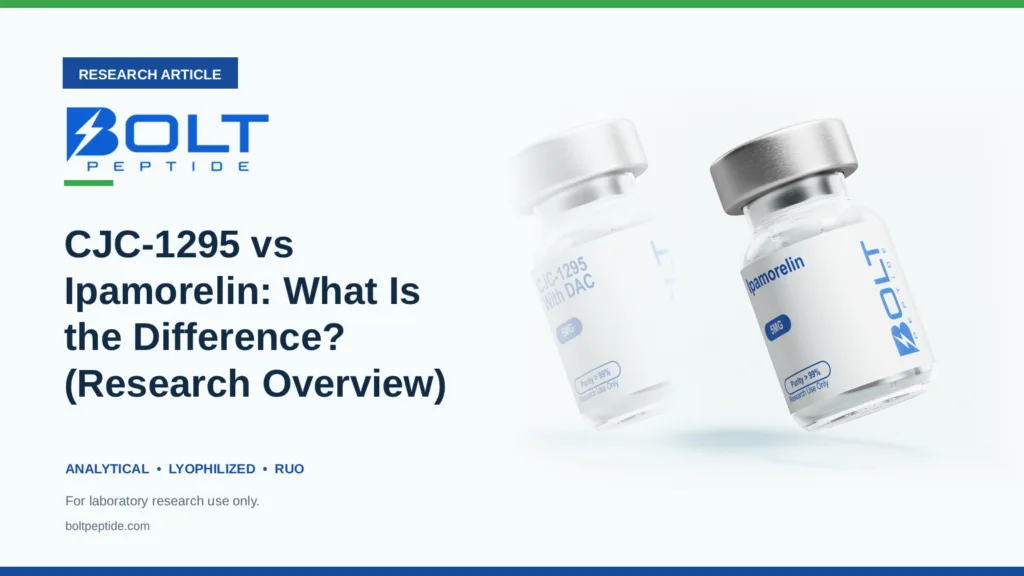
The short answer: both CJC-1295 and Ipamorelin act on the growth-hormone (GH) axis, but through entirely different receptors — which is exactly why researchers study them together. CJC-1295 is a long-acting growth-hormone-releasing hormone (GHRH) analog that binds the GHRH receptor, while Ipamorelin is a growth-hormone secretagogue (a ghrelin/GHS-receptor agonist) that binds a separate receptor. Because they engage two distinct, complementary pathways on the same axis, the CJC-1295/Ipamorelin pairing is one of the most commonly co-studied peptide combinations in preclinical literature.
Research-use-only (RUO) note: both peptides are sold strictly for laboratory and in-vitro research. Nothing below is a human, clinical, anti-aging, muscle, or therapeutic claim. All described effects come from preclinical, in-vitro, or animal studies. Not for human use.
Quick comparison
- Compound class — CJC-1295: GHRH analog (a modified GRF 1–29 peptide). Ipamorelin: growth-hormone secretagogue / GHRP-class pentapeptide.
- Receptor target — CJC-1295: the GHRH receptor (GHRH-R). Ipamorelin: the ghrelin receptor, also called the growth-hormone secretagogue receptor (GHS-R).
- Mechanism in research models — CJC-1295: mimics endogenous GHRH signaling at the pituitary. Ipamorelin: mimics ghrelin signaling, a parallel input to the same GH-releasing cells.
What is CJC-1295?
CJC-1295 is a synthetic analog of growth-hormone-releasing hormone (GHRH), characterized in research as a long-acting GHRH analog designed to bind endogenous albumin after injection, extending its half-life in study models. For a deeper breakdown of its structure, the DAC variant, and the preclinical pharmacology, see our full CJC-1295 article.
What is Ipamorelin?
Ipamorelin is a pentapeptide and one of the first selective growth-hormone secretagogues described in the literature. Unlike CJC-1295, it acts on the ghrelin/GHS receptor rather than the GHRH receptor. See our full Ipamorelin article.
Key differences studied in the lab
- Receptor — GHRH-R (CJC-1295) versus GHS-R / ghrelin receptor (Ipamorelin). This is the core distinction.
- Peptide family — CJC-1295 belongs to the GHRH-analog family; Ipamorelin belongs to the GHRP / secretagogue family.
- Duration in models — CJC-1295 was engineered for extended duration via albumin binding; Ipamorelin is a shorter-acting pentapeptide in research settings.
Why are they studied together?
The two are a popular research pair precisely because they hit different but complementary nodes of the same GH axis. CJC-1295 engages the GHRH-receptor pathway, while Ipamorelin engages the parallel ghrelin/GHS-receptor pathway. In preclinical study design, combining two independent inputs to the same signaling system is a common way to probe additive or synergistic mechanisms — the rationale behind the frequently referenced “CJC-1295 + Ipamorelin” combination. This is experimental rationale only, not an efficacy or human claim.
Research status and safety
Both CJC-1295 and Ipamorelin are supplied as research-use-only (RUO) materials for in-vitro and laboratory study. They are not approved by the FDA for human use, are not drugs, supplements, or cosmetics, and are not intended to diagnose, treat, cure, or prevent any disease. No dosing guidance is provided because these materials are not for administration to humans or animals.
Handling
Research peptides are typically shipped lyophilized and require reconstitution before laboratory use. See our laboratory concentration and handling reference, and browse the full peptide catalog.
FAQ
Are CJC-1295 and Ipamorelin the same thing? No. They are different peptide classes acting on different receptors — CJC-1295 on the GHRH receptor and Ipamorelin on the ghrelin/GHS receptor. They are discussed together because those pathways converge on the same GH axis.
Why are they sold as a combo? Because they target two distinct, complementary receptors, researchers commonly study them in parallel to examine combined mechanisms. This reflects experimental design, not any human benefit.
Can I use these peptides on myself? No. Both are strictly research-use-only and not approved for human use.
References
- Raun K, et al. Ipamorelin, the first selective growth hormone secretagogue. Eur J Endocrinol. 1998.
- Teichman SL, et al. Prolonged stimulation of GH and IGF-I by CJC-1295. J Clin Endocrinol Metab. 2006.
- Venkova K, et al. Efficacy of ipamorelin in a rodent model of postoperative ileus. J Pharmacol Exp Ther. 2009.
For research use only. Not for human or veterinary use. Not FDA-approved. Statements have not been evaluated by the FDA.
Source research-grade peptides from Bolt Peptide
Review current product availability and available documentation before ordering. Reference-lot records do not confirm the lot that will ship. For research use only.
Shop CJC-1295 / Ipamorelin Combo →Shop all research peptides