
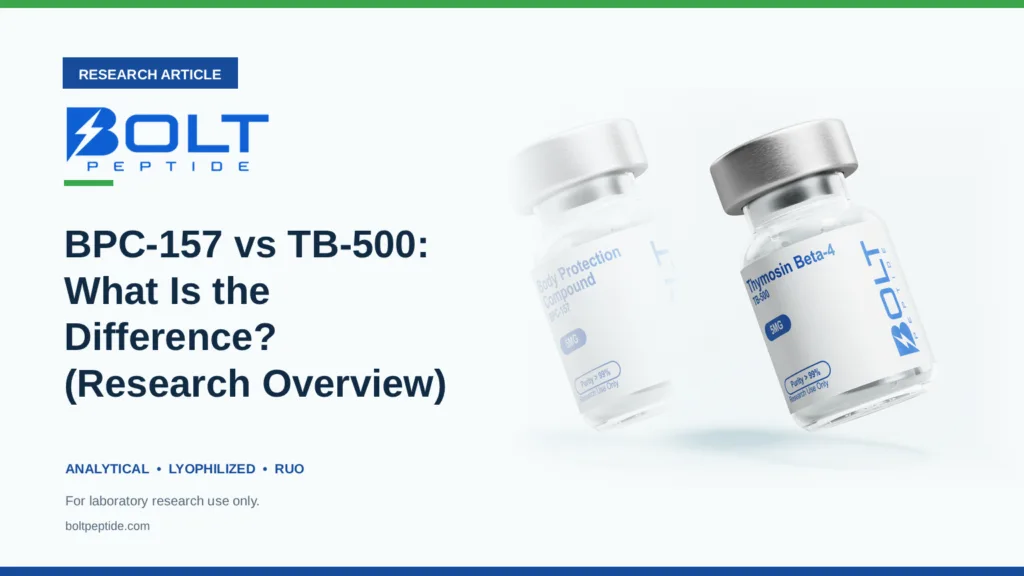
Both BPC-157 and TB-500 are research peptides studied in tissue-repair and cell-migration models, but they are chemically and mechanistically distinct. BPC-157 is a synthetic pentadecapeptide (15 amino acids) based on a partial sequence of a protein identified in gastric juice, whereas TB-500 is a synthetic peptide fragment that copies the actin-binding region of the protein thymosin β-4. The two are frequently studied side by side in preclinical literature and are combined in research blends such as Wolverine, GLOW, and KLOW. This article is an educational overview for research audiences only. Both peptides are sold strictly for research use only (RUO) — not for human or veterinary use, and nothing below is a healing or recovery claim for any person.
Quick comparison
- Origin: BPC-157 — synthetic pentadecapeptide from a partial gastric-juice protein sequence. TB-500 — synthetic fragment of thymosin β-4, a 43-amino-acid actin-binding protein.
- Structure: BPC-157 is 15 amino acids; TB-500 is a short acetylated fragment.
- Mechanism focus in the lab: BPC-157 — FAK–paxillin pathway and angiogenesis signaling; TB-500 — G-actin sequestration and actin regulation.
What is BPC-157?
BPC-157 is a stable synthetic pentadecapeptide whose sequence corresponds to a fragment of a protein identified in gastric juice. In preclinical and in-vitro studies it has been investigated for effects on fibroblast behavior, angiogenesis-related signaling, and tendon and muscle tissue models. See our full BPC-157 article.
What is TB-500?
TB-500 is a synthetic peptide corresponding to the active actin-binding region of thymosin β-4. Because thymosin β-4 functions largely by binding monomeric (G-)actin, TB-500 is studied chiefly in the context of actin regulation and cell motility in laboratory models. See our full TB-500 article.
Key differences studied in the lab
- BPC-157 — FAK–paxillin and angiogenesis: in one cell-culture study, BPC-157 increased phosphorylation of focal adhesion kinase (FAK) and paxillin and was associated with increased in-vitro outgrowth, survival, and migration of tendon fibroblasts [1].
- TB-500 — actin regulation and cell migration: as a thymosin β-4 fragment, TB-500 is studied for sequestering G-actin, a mechanism linked in the literature to endothelial and fibroblast cell-migration models [3].
- Different molecular entry points: the two are not the same molecule and engage different signaling and cytoskeletal pathways, which is one reason they are studied comparatively [2].
Are they studied together?
Yes. Because each peptide is associated with distinct mechanisms, they are frequently combined in multi-peptide research blends — commonly referred to as Wolverine, GLOW, and KLOW formulations — so both pathways can be examined in a single sample. Read more in our GLOW research overview.
Research status and safety
Neither BPC-157 nor TB-500 is an approved drug. Published reviews note the available human clinical evidence is insufficient to draw conclusions, and these compounds have not been approved by the FDA. All described effects come from in-vitro, animal, or other preclinical settings. These materials are sold for research use only and are not for human or veterinary use.
Handling
Both peptides are typically supplied as lyophilized powder and require reconstitution before laboratory use. See our laboratory concentration and handling reference, and browse the full research peptide catalog.
FAQ
Is BPC-157 or TB-500 “better”? Neither is established as better; they are different molecules studied for different mechanisms in preclinical models. Comparative effectiveness claims in humans are not supported by approved clinical evidence.
Are BPC-157 and TB-500 the same thing? No. BPC-157 is a 15-amino-acid pentadecapeptide based on a gastric-juice protein; TB-500 is a short fragment of thymosin β-4. They differ in origin, size, and studied mechanism.
Can I use these peptides? No. They are research-use-only materials, not for human or veterinary use, and we provide no dosing guidance.
References
- Chang CH, et al. The promoting effect of BPC 157 on tendon healing. J Appl Physiol. 2011.
- Józwiak M, et al. Multifunctionality and Possible Medical Application of the BPC 157 Peptide (review). Pharmaceuticals. 2025.
- Thymosin beta4 Promotes Dermal Healing (TB-500 / Tbeta4 mechanism). 2016.
For research use only. Not for human or veterinary use. Not FDA-approved. Statements have not been evaluated by the FDA.
Source research-grade peptides from Bolt Peptide
Review current product availability and available documentation before ordering. Reference-lot records do not confirm the lot that will ship. For research use only.
Browse Research Peptides →