
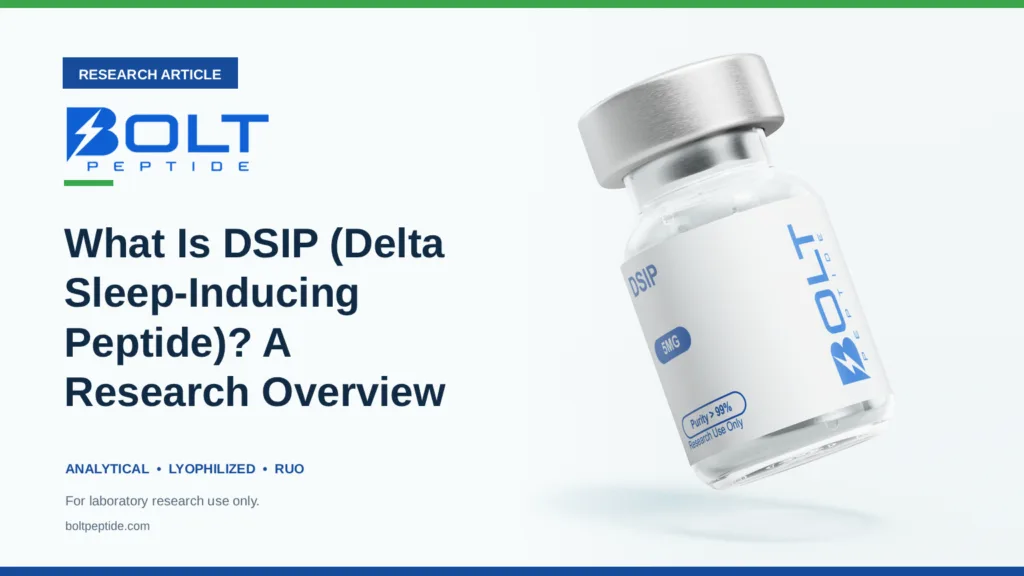
DSIP (delta sleep-inducing peptide) is a nonapeptide — a nine-amino-acid neuropeptide (Trp–Ala–Gly–Gly–Asp–Ala–Ser–Gly–Glu, molecular weight ≈849) first isolated from rabbit cerebral blood in 1977 and studied as a candidate sleep-regulating and stress-modulating factor in laboratory models. This article summarizes the preclinical literature for educational purposes only. DSIP is sold strictly as a research-use-only (RUO) material. It is not a drug, not a dietary supplement, and not for human or veterinary use.
Quick facts
- Class: nonapeptide neuropeptide
- Sequence: Trp–Ala–Gly–Gly–Asp–Ala–Ser–Gly–Glu (MW ≈849)
- Research focus: neuropeptide and sleep-physiology research; neuroendocrine and stress-response models
- Form: lyophilized powder for laboratory research use only
What is DSIP?
Delta sleep-inducing peptide (DSIP) is a short, naturally occurring neuropeptide first isolated in 1977 from the cerebral venous blood of rabbits. Its name comes from early observations that infusing the peptide appeared to increase delta-wave (slow-wave) EEG activity in animal models. Structurally, DSIP is unusual: its sequence does not closely match any other established peptide family, which has made it a long-standing subject of basic neuroscience research. Because no definitive DSIP gene or dedicated receptor has been isolated, the peptide remains an open research question.
What does the research show?
The available evidence is preclinical — from in-vitro work and animal models — and is mixed. An early comprehensive review described DSIP as a nonapeptide reported to influence delta-sleep across several species in some experiments, alongside effects on circadian patterns and hormonal regulation [1]. A later review in the Journal of Neurochemistry emphasized that the link between DSIP and sleep was never fully characterized; native DSIP showed limited sleep-promoting activity in some studies, while certain synthetic analogues promoted slow-wave sleep in rabbits and rats [2]. Work in rats reported that DSIP produced measurable shifts in substance P, beta-endorphin, and corticosterone within stress-response paradigms [3]. These are observations in non-human research systems and do not establish any effect in humans.
Mechanisms studied in the lab
- Slow-wave sleep modulation: changes in delta-band EEG activity reported in some animal models, more consistently with synthetic analogues than native DSIP.
- Neuroendocrine signaling: reported shifts in hypothalamic and plasma corticosterone and beta-endorphin in rodent stress paradigms.
- Neuropeptide interactions: measured changes in substance P content following administration in rats.
The absence of an identified DSIP receptor means the precise molecular mechanism remains unresolved.
Research status and safety
DSIP is offered exclusively as a research-use-only chemical for in-vitro and laboratory investigation by qualified researchers. It is not approved by the FDA, is not a medicine or supplement, and is not for human or animal consumption.
Handling
DSIP ships as a lyophilized (freeze-dried) powder, generally stored cold and protected from light and moisture. For step-by-step laboratory procedure, see our laboratory concentration and handling reference, and browse related materials in the full catalog. Product details: DSIP — product details.
FAQ
Is DSIP a nonapeptide? Yes. DSIP consists of nine amino acids (Trp–Ala–Gly–Gly–Asp–Ala–Ser–Gly–Glu) with a molecular weight of approximately 849.
Where was DSIP originally identified? It was isolated in 1977 from the cerebral venous blood of rabbits and has since been studied across multiple animal models.
Can I use DSIP for sleep? No. DSIP is a research-use-only material studied only in preclinical settings. It is not approved for human use, and no human use is intended or implied.
References
- Graf MV, Kastin AJ. Delta-sleep-inducing peptide (DSIP): a review. Neurosci Biobehav Rev. 1984.
- Kovalzon VM, Strekalova TV. DSIP: a still unresolved riddle. J Neurochem. 2006.
- Sudakov KV, et al. DSIP in mechanisms of resistance to emotional stress. Ann N Y Acad Sci. 1995.
For research use only. Not for human or veterinary use. Statements have not been evaluated by the FDA.
Source research-grade peptides from Bolt Peptide
Review current product availability and available documentation before ordering. Reference-lot records do not confirm the lot that will ship. For research use only.
Browse Research Peptides →