
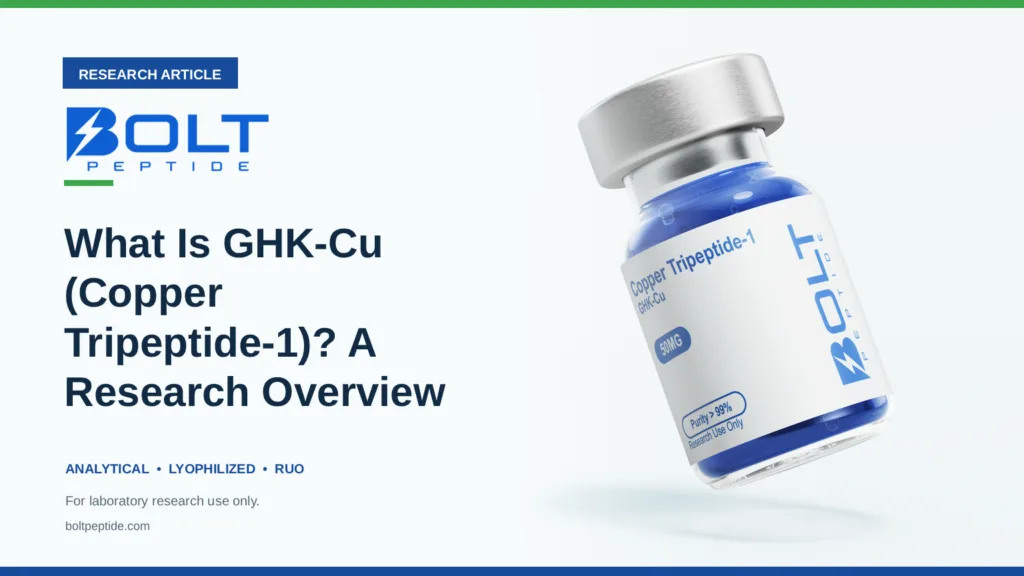
GHK-Cu (copper tripeptide-1) is a naturally occurring copper-binding tripeptide — glycyl-L-histidyl-L-lysine complexed with a copper(II) ion — that researchers study for its role in extracellular-matrix remodeling, gene modulation, and tissue-repair signaling in cell and animal models. It is offered strictly as a research-use-only (RUO) reference compound. It is not approved for human or veterinary use and is not intended to diagnose, treat, cure, or prevent any condition.
Quick facts
- Class: copper-binding tripeptide (copper tripeptide-1; glycyl-L-histidyl-L-lysine–Cu)
- CAS: 89030-95-5 (GHK-Cu complex); the free GHK tripeptide is 49557-75-7
- Research focus: wound-healing models, collagen/ECM gene expression, antioxidant and anti-inflammatory signaling
- Form: lyophilized powder for laboratory research use only
What is GHK-Cu?
GHK is a short peptide sequence (glycine–histidine–lysine) first isolated from human plasma and described by Loren Pickart in the 1970s. The histidine and lysine residues give the peptide a high affinity for copper(II) ions, so under physiological conditions GHK readily forms the GHK-Cu complex. In the published literature, this copper complex — rather than the free peptide alone — is the form most associated with the molecule’s reported activity in laboratory systems. Researchers study GHK-Cu as a model for how endogenous copper-peptide complexes may participate in connective-tissue signaling.
What does the research show?
The GHK-Cu literature is predominantly preclinical — in vitro cell culture and animal studies. Reviews by Pickart and colleagues summarize reports that GHK-Cu is associated, in cultured fibroblasts and animal models, with increased synthesis of collagen, elastin, and glycosaminoglycans, and with up- and down-regulation of large sets of genes linked to extracellular-matrix turnover, inflammation, and antioxidant defense. In one controlled animal study using an irradiated rat dorsal-flap model, investigators evaluated a topical copper-tripeptide complex against a control ointment. These findings describe responses in cell and animal systems only and do not establish any effect in humans.
Mechanisms studied in the lab
- Copper delivery and ECM enzymes: studied as a carrier of copper to enzymes involved in collagen and elastin cross-linking and matrix remodeling.
- Gene modulation: microarray work cited in review articles reports broad changes in gene expression, including genes tied to tissue repair and inflammatory pathways.
- Antioxidant and anti-inflammatory signaling: in vitro models report dampening of oxidative stress and pro-inflammatory mediators.
- Angiogenic and trophic signaling: animal and cell studies report associations with vascular and growth-factor signaling relevant to tissue regeneration.
Research status and safety
GHK-Cu is not an approved drug for human or veterinary use, and the evidence base described above is preclinical. It has not been evaluated by the FDA for safety or efficacy in people. No human-dosing guidance is provided or implied here. Material sold on this page is intended exclusively for in-vitro and laboratory research by qualified personnel.
Handling
GHK-Cu is supplied as a lyophilized research material and may display the characteristic blue color of its copper complex. Qualified laboratory personnel must establish storage, solvent compatibility, material handling, final concentration, light-exposure controls, and stability criteria under documented institutional SOPs. Review available product- and lot-specific documentation before laboratory work. See GHK-Cu — product details or browse the research peptide catalog.
FAQ
Is GHK-Cu approved for human use?
No. GHK-Cu is offered for research use only. It is not FDA-approved and is not intended for human or veterinary use. The available data are from in-vitro and animal studies.
Why is GHK-Cu blue?
The blue color comes from the coordinated copper(II) ion in the complex. It is a normal visual characteristic of the GHK-Cu complex and is unrelated to any human application.
How should GHK-Cu be stored in the lab?
Follow the product label and any available product- or lot-specific documentation. Qualified laboratory personnel should define storage, solvent compatibility, light-exposure controls, and stability criteria under documented institutional SOPs.
References
- Pickart L, et al. GHK Peptide as a Natural Modulator of Multiple Cellular Pathways in Skin Regeneration. BioMed Research International. 2015.
- Pickart L, Margolina A. Regenerative and Protective Actions of the GHK-Cu Peptide in the Light of the New Gene Data. Int J Mol Sci. 2018.
- Parker NP, et al. Topical copper tripeptide complex in an irradiated rat wound model. Otolaryngol Head Neck Surg. 2013.
For research use only. Not for human or veterinary use. Statements have not been evaluated by the FDA.
Source research-grade peptides from Bolt Peptide
Review current product availability and available documentation before ordering. Reference-lot records do not confirm the lot that will ship. For research use only.
GHK-Cu research peptide →Shop all research peptides