
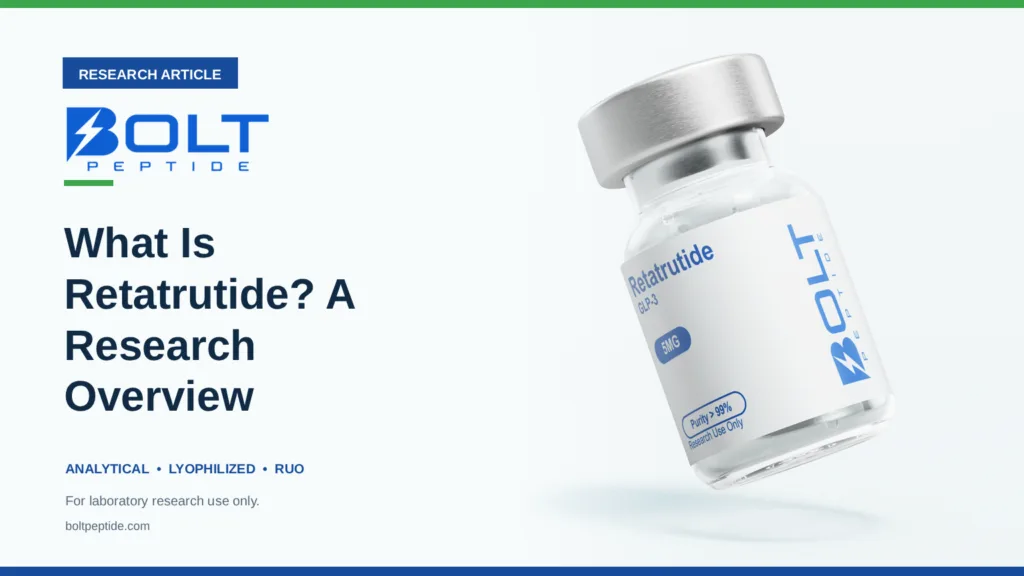
Retatrutide is an investigational triple GIP/GLP-1/glucagon receptor agonist — a single peptide engineered to bind three metabolic hormone receptors at once. It is currently in clinical trials and is not approved by the FDA for any use. Material offered here is sold strictly for research use only (RUO) and is not for human or veterinary use.
Quick facts
- Class: triple GIP/GLP-1/glucagon receptor agonist (single-molecule)
- Status: investigational — under evaluation in clinical trials, not FDA-approved
- Research focus: metabolic research
- Identifier: also referenced in the literature as LY3437943
- Form: lyophilized powder for laboratory research use only
What is Retatrutide?
Retatrutide is a synthetic peptide designed as a single molecule that activates three distinct receptors involved in metabolic signaling: the glucose-dependent insulinotropic polypeptide (GIP) receptor, the glucagon-like peptide-1 (GLP-1) receptor, and the glucagon (GCG) receptor. This “triple agonist” approach distinguishes it from single-receptor and dual-receptor peptides that have been characterized in earlier metabolic research. In published reports, retatrutide is conjugated to a fatty diacid moiety, a structural feature associated with extended circulation in study models. Because retatrutide remains an investigational compound, any material supplied is intended solely for in–vitro and laboratory research, not for consumption.
What does the research show?
Retatrutide has been examined in several peer-reviewed, randomized phase 2 studies. It is important to note that these are clinical-research findings in investigational settings — the compound is not approved, and the results below describe what was observed in trials, not outcomes for any reader.
Published phase 2 studies characterize retatrutide across metabolic, glycemic, and imaging endpoints under controlled investigational protocols [1][2][3]. These citations are included only to document the scientific record and experimental models; they do not provide a route, amount, protocol, or expected outcome for any Bolt material.
Mechanisms studied in the lab
- GIP receptor: an incretin pathway implicated in insulin secretion and nutrient signaling in research models.
- GLP-1 receptor: an incretin pathway widely studied for its role in glucose-dependent insulin response and appetite signaling.
- Glucagon (GCG) receptor: a pathway studied in connection with hepatic glucose handling and energy expenditure in preclinical research.
The scientific interest in retatrutide lies in engaging all three pathways simultaneously within a single molecule, which researchers study to compare against mono- and dual-receptor agonists.
Research status and safety
Retatrutide remains an investigational literature compound. Any Bolt Peptide reference material is supplied only for controlled in-vitro laboratory and analytical research by qualified professionals. It is not for human or veterinary use or consumption, and nothing here is a claim of benefit for any person.
Handling
Retatrutide reference material is supplied in lyophilized form for controlled laboratory study. Qualified personnel must establish storage, solvent compatibility, material handling, and final concentration under the applicable protocol and SOP. See the laboratory concentration and handling reference, browse related GLP research materials, or review Retatrutide product details.
FAQ
How does retatrutide differ from semaglutide and tirzepatide? In the research literature, semaglutide is characterized as a single GLP-1 receptor agonist and tirzepatide as a dual GIP/GLP-1 receptor agonist. Retatrutide is described as a triple agonist, adding glucagon (GCG) receptor activity to the GIP and GLP-1 targets.
What is the research status of retatrutide? It remains an investigational compound in the published literature. Bolt Peptide materials are research-use-only references and are not for human use.
What does “triple agonist” mean? It means one peptide molecule is engineered to activate three different receptors — GIP, GLP-1, and glucagon — rather than just one or two.
References
- Jastreboff AM, Kaplan LM, Frías JP, et al. Triple-Hormone-Receptor Agonist Retatrutide for Obesity — A Phase 2 Trial. N Engl J Med. 2023;389(6):514–526. PubMed 37366315
- Rosenstock J, Frías J, Jastreboff AM, et al. Retatrutide for people with type 2 diabetes: a phase 2 trial. Lancet. 2023;402(10401):529–544. PubMed 37385280
- Sanyal AJ, et al. Triple hormone receptor agonist retatrutide for MASLD: a phase 2a trial. Nat Med. 2024;30(7):2037–2048. PMC11271400
For research use only. Not for human or veterinary use. Statements have not been evaluated by the FDA.
Source research-grade peptides from Bolt Peptide
Review current product availability and available documentation before ordering. Reference-lot records do not confirm the lot that will ship. For research use only.
Shop Retatrutide →Shop all research peptides