
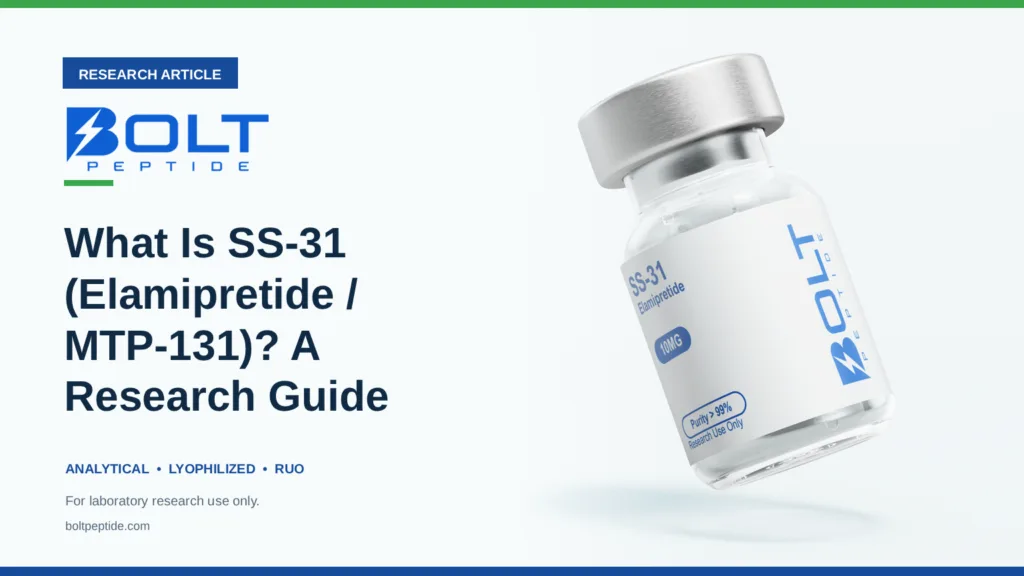
SS-31, also known as elamipretide or MTP-131, is a synthetic mitochondria-targeting tetrapeptide that binds cardiolipin on the inner mitochondrial membrane. It is studied in mitochondrial bioenergetics, oxidative-stress, and cellular-energy research. Any Bolt Peptide reference material is research-use-only and not for human or veterinary use.
Quick facts
- Class: Szeto–Schiller (SS) mitochondria-targeted tetrapeptide
- Other names: elamipretide, MTP-131 (formerly Bendavia)
- Sequence studied in the literature: D-Arg-Dmt-Lys-Phe-NH₂
- Molecular target: cardiolipin, a phospholipid of the inner mitochondrial membrane
- Research focus: mitochondrial bioenergetics, electron transport, and reactive oxygen species
What is SS-31?
SS-31 is a member of the Szeto–Schiller family of small, cell-permeable peptides developed to concentrate within mitochondria. In the research literature it is described as a synthetic tetrapeptide whose alternating aromatic and basic residues give it a net positive charge. This charge profile drives electrostatic attraction to negatively charged cardiolipin, allowing the peptide to accumulate at the inner mitochondrial membrane — the site of oxidative phosphorylation. In a clinical-research context the same molecule is referred to as elamipretide. The discussion below summarizes published findings; it does not describe outcomes for any reader.
What does the research show?
Published sources include cell-culture, animal-model, and controlled investigations of mitochondrial bioenergetics and cardiolipin interaction (Karaa et al., 2018; Campbell et al., 2019; Tung et al., 2025). These sources are cited only to document experimental models and mechanistic observations; they do not provide a route, amount, protocol, or expected outcome for any Bolt material.
Mechanisms studied in the lab
- Cardiolipin binding: SS-31 binds cardiolipin in the inner mitochondrial membrane, studied for effects on membrane organization and cristae structure.
- Electron transport and ATP: the literature describes enhanced assembly and stability of respiratory complexes (I, III, IV) and more efficient electron transfer, studied as a route to improved ATP synthesis.
- Reactive oxygen species (ROS): by reducing electron leakage along the electron transport chain, SS-31 is studied for its effect on mitochondrial ROS production and oxidative stress markers.
Research status
SS-31 / elamipretide appears in investigational and regulatory literature. Commercial product status is outside the scope of this research-material overview and does not apply to Bolt Peptide reference material. Any material supplied here is strictly for controlled in-vitro laboratory research by qualified professionals and is not for human or veterinary use.
Related research peptides
If you study mitochondrial metabolism and cellular energy pathways, explore the full research peptide catalog, and read our educational articles on MOTS-c, a mitochondrial-derived peptide studied in metabolic research, and NAD+, a coenzyme central to mitochondrial energy metabolism.
FAQ
Is SS-31 the same as elamipretide? Yes. SS-31, elamipretide, and the former code name MTP-131 refer to the same mitochondria-targeted tetrapeptide. “SS-31” is most common in laboratory literature, while “elamipretide” is the name used in clinical development.
How does SS-31 target mitochondria? In published research, its positively charged residues are attracted to cardiolipin, a phospholipid concentrated in the inner mitochondrial membrane, which drives its accumulation within mitochondria.
What is the intended context for research-grade SS-31? Controlled in-vitro laboratory investigation by qualified professionals only. It is not for human or veterinary use.
References
- Tung C, et al. Elamipretide: A Review of Its Structure, Mechanism of Action, and Therapeutic Potential. Int J Mol Sci. 2025.
- Karaa A, et al. Randomized dose-escalation trial of elamipretide in primary mitochondrial myopathy (MMPOWER). Neurology. 2018.
- Campbell MD, et al. Improving mitochondrial function with SS-31 in aged mice. Free Radic Biol Med. 2019.
For research use only. Not for human or veterinary consumption. The narrow FDA approval of elamipretide (Forzinity) for Barth syndrome applies only to that finished prescription drug, not to research-grade materials. Statements have not been evaluated by the FDA.
Source research-grade peptides from Bolt Peptide
Review current product availability and available documentation before ordering. Reference-lot records do not confirm the lot that will ship. For research use only.
Shop MOTS-C →Shop all research peptides