
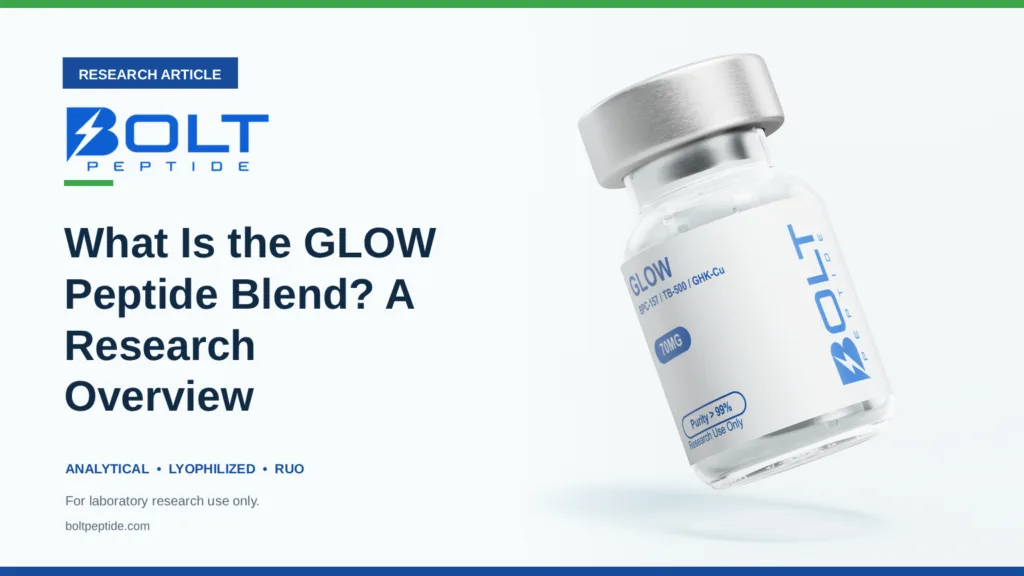
GLOW is a research peptide blend that combines three separate research compounds in one lyophilized vial — GHK-Cu, BPC-157, and TB-500. It is not a single molecule and is not an independently studied drug; it is a blend whose individual components each have their own preclinical literature. GLOW is sold strictly for research use only (RUO). It is not a drug, supplement, or cosmetic, and it is not for human or veterinary use.
Quick facts
- Type: research peptide blend (three components in one vial)
- Components: GHK-Cu, BPC-157, and TB-500
- Form: lyophilized (freeze-dried) powder
- Documentation: Review any available product- or lot-specific Certificate of Analysis for reported methods and results.
- Status: for laboratory research use only — not for human use
What is the GLOW blend?
GLOW places three commonly researched peptides into a single vial. There are no published studies on the “GLOW blend” itself as a defined product, so it must be understood at the level of its individual components. Each of the three — GHK-Cu, BPC-157, and TB-500 — has been investigated separately in in-vitro and animal models, primarily in the context of tissue repair and skin biology. The sections below summarize what each component has been studied for, with citations.
The components
GHK-Cu is a copper-binding tripeptide (glycyl-L-histidyl-L-lysine complexed with copper). In preclinical and cell-culture models it has been studied as a modulator of skin-regeneration pathways, including extracellular-matrix remodeling and collagen-related signaling [1].
BPC-157 is a synthetic pentadecapeptide derived from a sequence found in gastric juice. In an ex-vivo/animal study, it promoted tendon-fibroblast outgrowth, cell survival under stress, and cell migration in vitro [2].
TB-500 is a synthetic fragment related to thymosin beta-4, a naturally occurring regenerative peptide. Thymosin beta-4 has been studied in animal wound models for re-epithelialization and angiogenesis [3].
Research status and safety
GLOW is supplied for research use only. The blend itself has not been evaluated as a finished product, and its components are research compounds not approved by the FDA for any human use. All findings here are from in-vitro, ex-vivo, or animal studies; nothing describes a benefit to a human reader, and no skin, recovery, or cosmetic effect in people is claimed or implied.
Handling
GLOW ships as a lyophilized powder and should be stored cool, dark, and dry until reconstituted. Because it is freeze-dried, it must be brought into solution before laboratory use — see our guide on laboratory concentration and handling reference. To view this and related research compounds, browse the catalog: View the GLOW Blend — product details.
FAQ
What is the difference between GLOW and KLOW? GLOW is a three-component blend (GHK-Cu, BPC-157, TB-500). KLOW is a four-component blend that adds KPV to the same three peptides.
Is the “GLOW blend” itself backed by clinical studies? No. There are no published studies on the GLOW blend as a defined product; the available research applies to its individual components.
Can GLOW be used on people? No. It is sold strictly for research use only and is not for human or veterinary use.
References
- Pickart L, et al. GHK Peptide as a Natural Modulator of Cellular Pathways in Skin Regeneration. Biomed Res Int. 2015.
- Chang CH, et al. The promoting effect of BPC 157 on tendon healing. J Appl Physiol. 2011.
- Malinda KM, et al. Thymosin beta4 accelerates wound healing. J Invest Dermatol. 1999.
For research use only. Not for human or veterinary use. Statements have not been evaluated by the FDA. All statements describe published in-vitro and animal research on the individual components only.
Source research-grade peptides from Bolt Peptide
Review current product availability and available documentation before ordering. Reference-lot records do not confirm the lot that will ship. For research use only.
GLOW blend research peptide →Shop all research peptides