
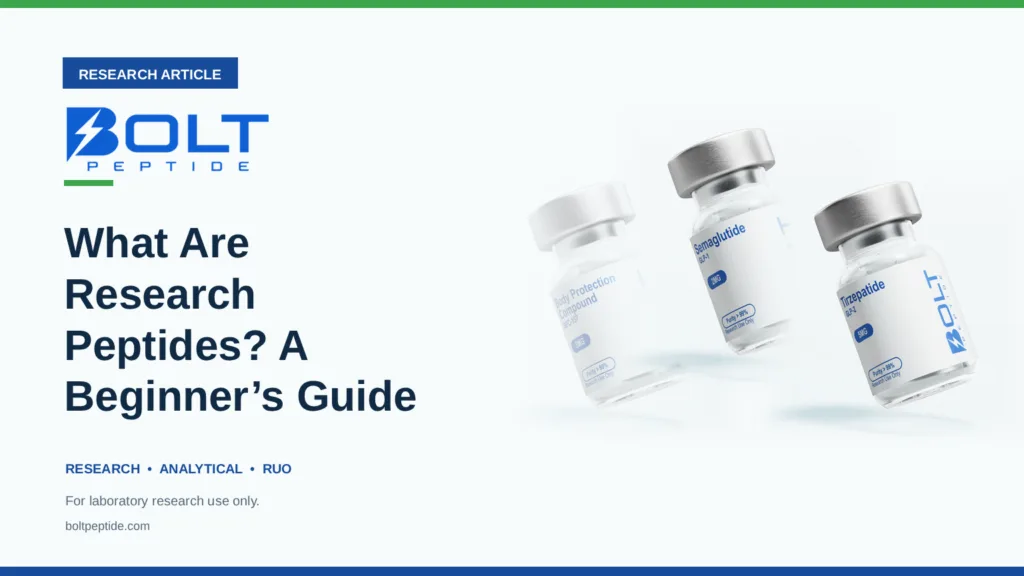
Research peptides are short chains of amino acids (typically ~2–50 residues) supplied as laboratory reference materials for in-vitro and preclinical study. The phrase “research use only” (RUO) means these materials are not drugs, dietary supplements, or products intended for human or veterinary use — they exist solely to support controlled laboratory investigation.
Everything below is provided for educational purposes only. All peptides referenced are research-use-only (RUO) materials. Nothing here describes, recommends, or implies human, clinical, or veterinary use.
What is a peptide?
A peptide is a molecule made of two or more amino acids joined by peptide bonds — the same covalent linkages that connect amino acids in proteins. Amino acids are the fundamental building blocks of biology, and the order in which they are arranged defines a peptide’s identity and properties. The main distinction between a peptide and a protein is size: by widely used convention, peptides typically comprise roughly 2–50 amino acid residues, while proteins are larger molecules made of dozens to thousands of residues folded into complex structures. The boundary is approximate, but the short-chain description captures what most research peptides are: small, defined sequences synthesized to a known specification.
What does “research use only” (RUO) mean?
Research use only is a labeling and compliance designation for materials intended for controlled laboratory investigation by qualified professionals. RUO peptides are reference compounds for in-vitro, biochemical, and other approved non-human research models. They are not for human or veterinary use or consumption, and product suitability must be evaluated under the laboratory’s protocol and SOP.
Common categories of research peptides
Research peptides are often grouped by the biological pathway they are studied in:
- Growth-hormone-axis peptides and secretagogues — e.g. CJC-1295, Ipamorelin, and Sermorelin.
- Incretin and metabolic peptides — e.g. Semaglutide and Tirzepatide.
- Repair-studied peptides — e.g. BPC-157 and TB-500.
- CNS and nootropic-studied peptides — e.g. Semax and Selank.
- Pigmentation peptides — e.g. Melanotan II.
These groupings describe the research areas in which each peptide is investigated; they are not statements about outcomes or uses. Browse available reference materials in the peptide catalog.
How research peptides are supplied and handled
Many research peptides are supplied in lyophilized form. Lyophilization describes a physical state; it does not by itself establish identity, purity, sterility, stability, or assay suitability. Qualified personnel must determine solvent compatibility, material handling, final concentration, and storage controls under an approved protocol and SOP. See the laboratory concentration and handling reference and laboratory storage controls.
How to read a certificate of analysis (COA)
A certificate of analysis (COA) is a quality document that accompanies a research peptide and reports laboratory testing for that batch. Two of the most important fields are:
- Purity — usually determined by high-performance liquid chromatography (HPLC), reported as a percentage; it indicates how much of the material is the intended peptide versus impurities.
- Identity — usually confirmed by mass spectrometry (MS), which verifies that the measured molecular mass matches the expected sequence.
Reviewing the COA helps a researcher confirm that a reference material is what it claims to be and meets the purity threshold appropriate for their work.
Research status and compliance
All peptides discussed here are research-use-only materials. They are not medicines, not supplements, and not intended for human or veterinary use. They have not been evaluated by the FDA for safety or efficacy in any such context. Handling, storage, and disposal should follow standard laboratory practice and applicable institutional and regulatory requirements.
FAQ
Are research peptides legal? In the United States, peptides sold and labeled as research-use-only reference chemicals occupy a different regulatory category from approved drugs and dietary supplements. They are intended for laboratory research, not for human or veterinary use, and must be handled accordingly. Researchers are responsible for complying with all applicable federal, state, and institutional rules.
What is the difference between a peptide and a protein? Both are chains of amino acids linked by peptide bonds. The difference is size: peptides are short chains (commonly ~2–50 residues), while proteins are larger and fold into more complex structures. The cutoff is a convention, not a hard rule.
Can I use research peptides? No. Research-use-only peptides are not for human or veterinary use of any kind. They are reference materials intended exclusively for qualified researchers performing in-vitro and preclinical laboratory study.
References
- Wang L, et al. Therapeutic peptides: current applications and future directions. Signal Transduct Target Ther. 2022;7:48.
- Bachem Knowledge Center — peptide chemistry and handling references.
For research use only. Not for human or veterinary use; not intended to diagnose, treat, cure, or prevent any disease. Statements have not been evaluated by the FDA.
Source research-grade peptides from Bolt Peptide
Review current product availability and available documentation before ordering. Reference-lot records do not confirm the lot that will ship. For research use only.
Browse Research Peptides →