
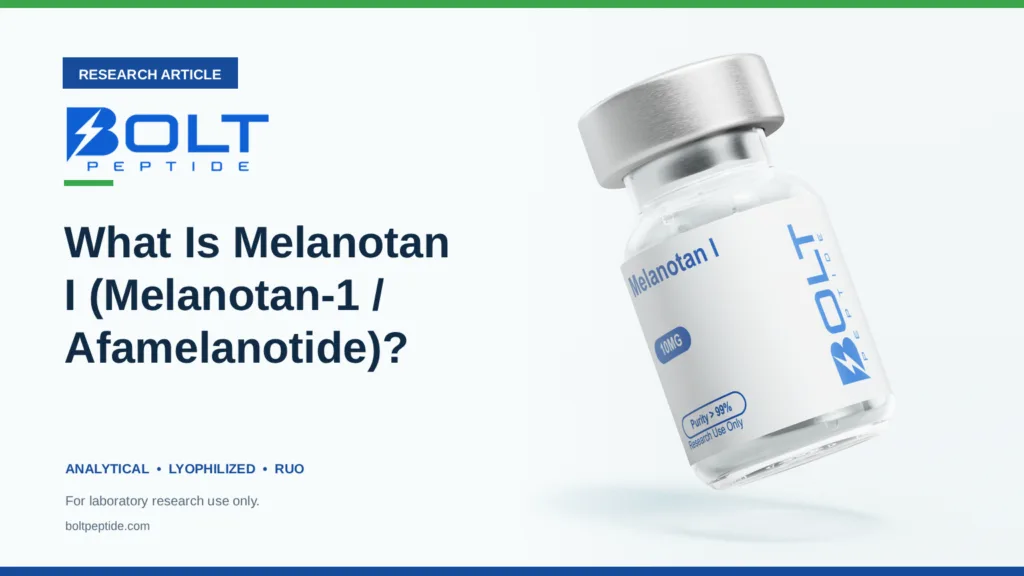
Melanotan I is a synthetic analog of alpha-melanocyte-stimulating hormone (α-MSH), studied in laboratory melanocortin-receptor and pigmentation models. Bolt Peptide material is supplied strictly for controlled in-vitro laboratory research by qualified professionals. It is not a finished pharmaceutical product and is not for human use.
Quick facts
- Class: synthetic α-MSH analog / melanocortin-receptor agonist
- Research focus: melanocortin-receptor signaling and pigmentation research
- Primary target studied: the melanocortin-1 receptor (MC1R)
- Regulatory status: research materials are RUO; the related analog afamelanotide has an approved medical use for EPP
- Not for human use: for in-vitro and laboratory research only
What is Melanotan I?
Melanotan I refers to a synthetic peptide modeled on α-MSH, one of the body’s natural melanocortin hormones. In the research literature, the most-studied compound in this family is afamelanotide — chemically [Nle4, D-Phe7]-α-MSH (also written NDP-α-MSH) — which differs from natural α-MSH at two amino-acid positions, changes that make the molecule more stable and longer-acting in laboratory studies. Because melanocortin peptides act on receptors that influence melanin production, Melanotan I has been used in preclinical and clinical research as a tool to probe pigmentation biology. Any references to effects below describe findings in controlled research settings, not outcomes for a consumer.
Melanotan I vs Melanotan II
These are two distinct peptides that are easy to confuse. The key difference is selectivity. Melanotan I is a more selective α-MSH analog whose research has centered on the melanocortin-1 receptor (MC1R). Melanotan II is a different, structurally smaller and broader melanocortin agonist that interacts with a wider set of melanocortin receptors (including MC3R and MC4R) in laboratory studies. Same hormone family, different molecules, different receptor profiles. For more, see our Melanotan II article and our full Melanotan I vs Melanotan II comparison.
Mechanisms studied in the lab
- MC1R agonism: Melanotan I peptides bind and activate the melanocortin-1 receptor (MC1R) on pigment-producing cells in research models.
- Eumelanin synthesis: MC1R activation has been studied for its role in driving production of eumelanin, the darker melanin pigment.
- MC1R variants: research has examined how α-MSH analogs behave in cells and individuals carrying MC1R variant alleles, which alter receptor signaling.
Research status
Published literature distinguishes afamelanotide and Melanotan I materials by formulation, regulatory context, and study design. This article addresses only the molecular and analytical research record. Bolt Peptide material is research-use-only, is not a finished commercial product, and is not for human or veterinary use.
Handling
Melanotan I is supplied in lyophilized form. Qualified personnel must establish solvent compatibility, material handling, and final concentration under an approved protocol and SOP. See the laboratory concentration and handling reference.
FAQ
How is Melanotan I described in the literature? It is an α-MSH analog discussed alongside afamelanotide in molecular and receptor research. Bolt Peptide material is a research-use-only reference and not a finished commercial product.
How is Melanotan I different from Melanotan II? Melanotan I is a more selective α-MSH analog studied mainly at MC1R, whereas Melanotan II is a separate, broader melanocortin agonist. See our full comparison for details.
What is the intended context for Melanotan I? Controlled in-vitro laboratory research by qualified professionals only. It is not for human or veterinary use.
References
- Fitzgerald LM, et al. Effect of MELANOTAN [Nle4, D-Phe7]-alpha-MSH on melanin synthesis in humans with MC1R variant alleles. Peptides. 2006.
- Langendonk JG, et al. Afamelanotide for Erythropoietic Protoporphyria. N Engl J Med. 2015.
- Böhm M, et al. Benefits and risks of chronic melanocortin-1 receptor activation (review). J Eur Acad Dermatol Venereol. 2025.
For research use only. Not a drug, food, cosmetic, or supplement; not for human or veterinary use. Statements have not been evaluated by the FDA.
View the product: Melanotan I, or browse the full peptide catalog.
Source research-grade peptides from Bolt Peptide
Review current product availability and available documentation before ordering. Reference-lot records do not confirm the lot that will ship. For research use only.
Browse Research Peptides →